

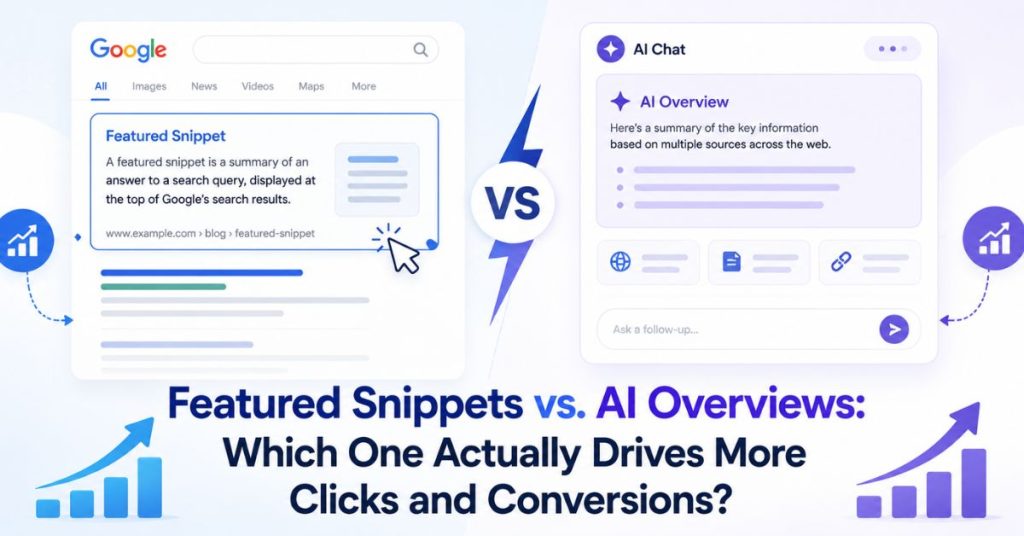
Search results don’t look the way they did even two years ago. You used to check one box for organic traffic and rankings, get a top spot, and watch the clicks roll in. Now there’s a second, more complicated question: does it really matter if you rank first when an AI-generated answer appears above your listing and answers the question before anyone clicks through?
This is the exact debate we have with clients every week at our agency. Businesses want to know whether chasing a featured snippet still makes sense or whether the real prize now is showing up inside an AI overview. The honest answer is that both matter, but they behave very differently, and understanding that difference is what separates a strong SEO agency in Abu Dhabi from one that’s still optimizing for a search landscape that no longer exists.
What Are Featured Snippets, Really?
Featured snippets are the boxed answers that appear at the very top of Google’s results, pulled directly from a page on the web and marked “position zero”. They’ve been around since 2014 and still show up for millions of queries, especially “how to”, “what is”, and comparison-style searches.
A few things make this format valuable:
- They carry a visible source link. Unlike some AI-generated answers, a snippet always shows the URL and page title it pulled from, right there on the results page.
- They’re earned through structure, not just authority. A well-formatted page with clear headers, short direct answers, and lists can outrank a bigger competitor for the snippet slot.
- They still send traffic. Studies consistently show that snippet positions get meaningfully higher click-through rates than the standard #1 organic listing without a snippet.
What Are AI Overviews, and Why Are They Different?
AI Overviews are Google’s generative, conversational summaries that appear above traditional search results for many queries. Instead of pulling one direct excerpt like a snippet does, an AI overview synthesises information from several sources into a single written answer, sometimes citing three or four pages at once.
Here’s where it gets tricky for businesses:
- Citations are smaller and less prominent. A page might be one of four or five sources cited within an AI overview, sharing visibility rather than owning it outright.
- The answer is often complete enough that users don’t scroll further. This is the biggest concern site owners raise: if the AI Overview fully answers the question, why would anyone click through at all?
- They cover more complex queries. While a boxed answer tends to handle single, factual questions, the AI-generated summary increasingly appears for broader, multi-part searches where users are researching rather than looking for one quick fact.
Clicks: Where the Real Difference Shows Up
The click-through rate is the part that actually affects your business. Multiple industry studies published through 2025 and into 2026 have shown organic click-through rates dropping on pages where an AI overview appears above the results, sometimes by a significant margin compared to identical queries without one. The boxed-answer format, by contrast, has generally maintained its click-through advantage over standard listings because it invites a click for more detail or context rather than eliminating the need for one.
That doesn’t mean this generative format is worthless for traffic. Being cited inside one still builds visibility and brand recognition, even for users who don’t click immediately. But if pure click volume is your priority, ranking for a featured snippet is currently the safer, more measurable bet.
Conversions: A Different Story Entirely
Clicks and conversions aren’t the same metric, and this is where a lot of businesses get their strategy wrong. While a Featured Snippet may drive more overall traffic to your site, not all of that traffic is ready to buy. Someone searching “what is technical SEO” and clicking your snippet is often still in research mode.
AI Overview citations, on the other hand, tend to appear for more complex, higher-intent queries, and users who do click through after reading a full AI summary are often further along in their decision. They’ve already had their basic question answered; clicking your link means they want depth, proof, or a next step, which usually converts at a better rate.
So the pattern we see across client accounts looks like this:
- The boxed-answer format generally drives higher click volume.
- AI Overview citations often produce lower click volume but higher intent per click.
- The strongest strategy targets both, rather than picking one over the other.
Which One Should You Prioritize?
There’s no universal answer, and any consultant who gives you one without looking at your specific industry and query set isn’t being straight with you. What actually works is auditing which of your target keywords currently trigger a boxed answer, a generative summary, or neither. From there, you structure content differently for each:
- For snippet opportunities, write tight, direct answers in the first 40 to 60 words after a header, followed by supporting detail.
- For AI Overview opportunities, focus on depth, clear sourcing, and content that answers the full scope of a topic, since Google’s systems tend to pull from pages that cover a query comprehensively rather than narrowly.
- For queries with neither yet, build strong foundational content now, since both formats increasingly reward pages that were already ranking well organically before the feature appeared.
What This Means for Your Content Calendar
Most businesses treat this as a one-time fix, but it isn’t. Google adjusts which format appears for which queries on a rolling basis, and a keyword that triggers a boxed answer today might shift to a generative summary next quarter, or lose the feature entirely. That means the audit described above isn’t a single project; it’s an ongoing part of how you plan content.
In practice, this changes what a monthly SEO report should actually track. Rankings alone don’t tell the full story anymore. You also need visibility into:
- Which queries currently show a generative summary, a boxed answer, both, or neither?
- How click-through rate on those specific pages moved over the past few months?
- Determine whether competitor content is cited in the summary format for shared target keywords.
Without that layer of tracking, it’s easy to assume your rankings are healthy while your actual visible traffic quietly erodes. This is exactly the kind of detail that separates a general marketing vendor from a team that lives inside search data every day.
Bringing It Together
These two formats aren’t competitors you have to choose between. They’re different visibility layers stacked on top of the same search results page, and ignoring either one means you’re missing out on traffic and revenue. The boxed-answer format still reliably pulls clicks for direct, factual searches, while the generative summary is reshaping how users research more complex topics, and getting cited there builds trust even before a click happens.
If your current content strategy hasn’t been rebuilt around this shift, you’re likely losing visibility you don’t even know is missing. That’s exactly the gap we’ve been closing for clients across industries over the past year, restructuring content to compete for both featured snippets and AI overviews at once. Working with the right SEO expert in Dubai means you’re not guessing which one matters. You’re building a content strategy engineered to win visibility in both, while your competitors are still arguing about which one is “better”.