

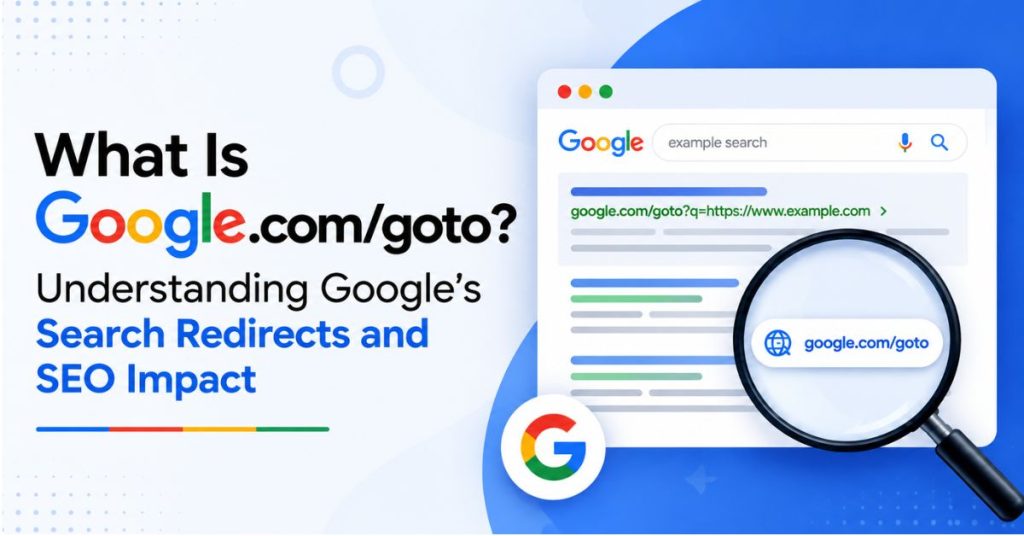
Google has started inserting a redirect layer into its organic search results, and the change is called Google.com/goto. Instead of sending a searcher directly from the results page to a website’s URL, Google now routes that click through a google.com/goto?url= parameter before the browser lands on the destination page. Search Engine Land confirmed the rollout in August 2026, and Search Engine Roundtable had already flagged the testing phase weeks earlier. Within days, industry trackers were reporting close to full deployment across residential IP ranges. For SEO specialists in Dubai, this one technical adjustment reaches further than it looks. It touches rank tracking accuracy, how referral data gets interpreted, and whether clients can trust the reports pulled from tools that were never built to expect an extra redirect hop. What follows covers the mechanics, Google’s stated reasoning, the practical fallout for tracking software, and what website owners should actually do about it.
What Is Google.com/goto and Why It Appeared in Search Results
Before this update, clicking a result in Google Search sent you straight to the destination URL. No middle step. The address bar showed the real page the moment you clicked.
That’s no longer true for a large share of queries. A click on a search result now passes through a URL structured as google.com/goto?url=[encoded destination], and only after that does the browser resolve to the actual page. Google put out an official statement on this rather than letting the community discover it on its own, which tells you the company expected pushback from SEOs and data teams and decided to get ahead of it.
How the New Redirect Mechanism Works
The mechanism is simple on paper. Every organic listing now carries a hashed or encoded URL parameter. Click the listing, and the browser first pings Google’s own domain. Google decodes the parameter server-side, then redirects to wherever the page actually lives.
Search Engine Land ran side-by-side screenshots of the old and new formats, and the difference jumps out immediately. Derek Perkins of Nozzle, quoted in that piece, said the rollout had hit near-total deployment across several residential IP providers in a short span. That’s not a limited A/B test. That’s Google restructuring how it hands off outbound links.
Why Google Introduced This Change
Google’s spokesperson called this one entry in a long-running series of technical measures against evolving abuse. No specific bad actor got named in the statement, but the timing is hard to ignore. Google sued SerpAPI over unauthorized scraping and lost a key motion in that case earlier in 2026. A courtroom setback like that tends to push engineering teams toward technical solutions faster than legal ones.
A redirect layer raises the cost of scraping. Third-party SERP trackers, competitive intelligence tools, and AI systems pulling structured data straight off result pages now hit an extra wall. A direct URL takes almost no effort to parse. A hashed redirect takes work, and Google can change the encoding whenever it wants, which turns scraping from a solved problem back into a moving target.
Impact on Rank Tracking Tools and Third-Party SEO Software
This is the part that actually lands on an agency’s desk. Rank trackers, SERP scrapers, and competitive intelligence tools were built for a world where search results linked straight to a URL. That assumption just broke. Vendors now have to rewrite parsing logic to follow the redirect correctly, and not every vendor moves at the same speed. Some will patch this within days. Others will sit on it for weeks, and during that gap, ranking numbers or click estimates in your dashboard might jump around for reasons that have nothing to do with actual performance.
Search Engine Land said it plainly: if you use third-party Google tracking tools, watch your numbers closely, and if something looks off, contact the vendor directly rather than assuming your rankings tanked overnight. That advice holds for agencies juggling client accounts just as much as it holds for a single in-house marketer staring at a weird spike.
What This Means for Google Search Console Data
Search Console should hold up fine here, since it pulls from Google’s own internal logs rather than scraping the public results page the way third-party tools do. The redirect sits in the front-end experience, not in the data pipeline behind impressions, clicks, and average position. Still, cross-check your Search Console numbers against whatever third-party tool you’re running during this stretch. “Should be unaffected” is worth confirming, not just assuming.
Impact on Searchers and Click-Through Behavior
For most people typing a query into Google, this barely registers. You can’t preview the final destination URL in the browser status bar anymore before you click, since the visible link now points to google.com/goto instead of the actual site. Google still shows the destination address under the title and snippet, so it’s a partial loss of transparency, not a total one.
There’s a narrower edge case worth flagging. If a compromised or malicious page somehow slips into Google’s index before detection, the redirect adds a fraction of a second of obscurity to that click path. Google has generally pulled flagged pages fast, and nothing about this change slows that process down. It only changes what happens in the moment before removal.
What SEO Teams and Website Owners Should Do Now
Don’t treat this as a five-alarm fire. Treat it as a reason to check your reporting stack before it checks you. Start by pulling a list of every rank tracker, analytics tool, and scraper your team relies on, then contact each vendor and ask directly whether their data collection method already accounts for the goto redirect. Next, run a side-by-side comparison between third-party click or ranking data and your own Search Console figures for the same date range. Gaps here are more likely to be tool lag than a real drop in performance. Keep a running note of any dashboard anomalies over the next few weeks. Skip that step, and an isolated glitch today gets misread as a genuine ranking crash three weeks from now.
Agencies handling multiple accounts feel this more than most. A client-facing report built on shaky data can dent trust even when the actual SEO work is solid. A short heads-up email explaining the Google.com/goto change, sent before a client spots a strange dip and asks about it, costs ten minutes and saves an awkward call.
Conclusion
Google.com/goto changes how clicks move from the search results page to a live website, and the motive behind it is scraping prevention, not a ranking overhaul. Businesses relying on accurate SEO reporting need to get their heads around this Google search results change soon, because a misread dashboard tends to steer strategy in the wrong direction. At Infinix360, catching platform-level shifts like this one before they cause confusion is just part of how we run client reporting, and it’s the same standard we hold across our SEO services in Abu Dhabi. Knowing about a change like this the week it happens, rather than the month after a client asks about it, is what actual SEO expertise looks like in practice.
Frequently Asked Questions
What is Google.com/goto?
It’s a redirect Google now inserts between a search result click and the actual destination page. Click a result, and instead of landing on the site directly, you pass through this intermediate address first.
Why did Google add the goto redirect to search results?
Google says it’s a technical measure against evolving abuse, aimed specifically at unauthorized scraping of search result data by third-party tools and AI systems.
Does the Google.com/goto change affect my website’s search ranking?
No. It changes how a click gets routed and how tracking tools read result pages. It has nothing to do with ranking algorithms or where your page lands in the results.
Is Google Search Console data affected by the goto redirect?
It shouldn’t be. Search Console draws from Google’s internal systems, not the public-facing results page. That said, running a quick comparison against a third-party tool during this transition isn’t a bad habit.
Can users still see the destination URL before clicking a search result?
Not in the browser’s status bar preview, which now shows google.com/goto. Google still lists the actual destination URL as text under each result’s title and snippet.
Is the Google.com/goto redirect a security risk for searchers?
Not really. It’s built to cut down on scraping, not to introduce a new vulnerability. Google’s process for yanking malicious pages from its index hasn’t changed because of this.
How long has Google been testing this feature?
Search Engine Roundtable was writing about goto-style tracking URLs months before Google confirmed the full rollout, so this wasn’t a rushed decision. Google ran it quietly for a while first.