

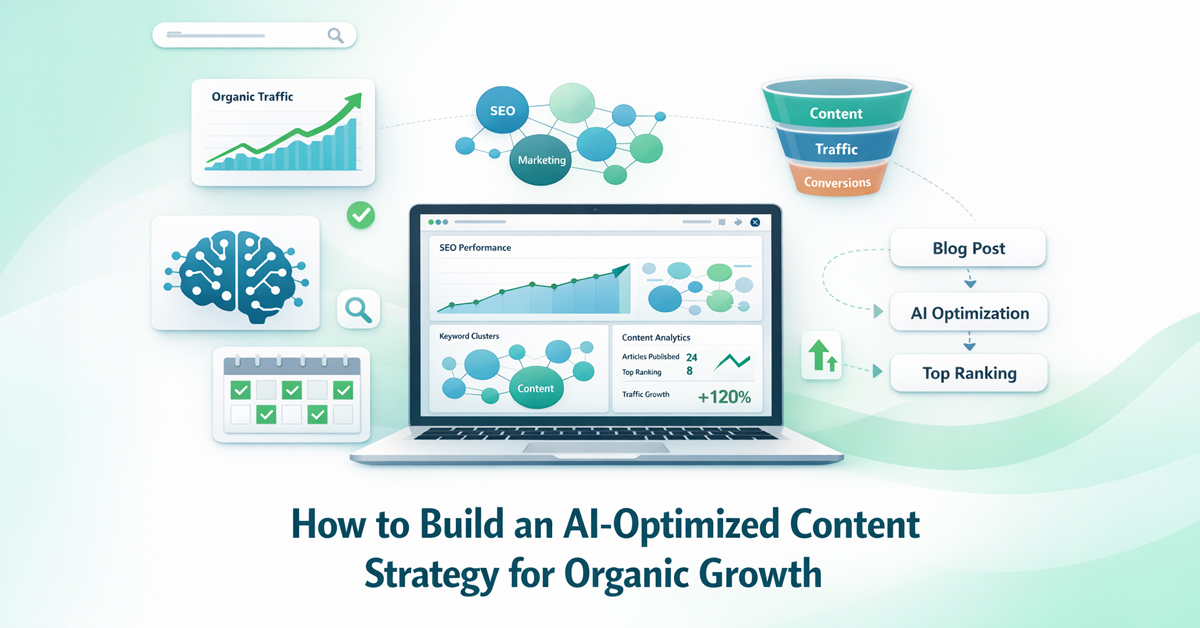
Content strategy used to mean picking the right keywords, publishing regularly, and hoping Google noticed. That formula is still relevant, but it’s no longer enough on its own. Search engines are now powered by AI systems that evaluate content differently: not just for keyword matches, but for context, intent, depth, and how well a page actually serves the person reading it. Businesses that adapt their content approach to meet these expectations are pulling ahead in organic rankings. Those still working from a 2020 playbook are quietly losing ground. If you’re looking at what the best SEO companies in Dubai are doing differently, it comes down to building content strategies around AI-powered SEO techniques that treat search engines and real readers as the same audience.
How to Create AI-Optimized Content
The phrase “AI-optimized content” doesn’t mean content written by AI. It means content structured, written, and distributed in a way that aligns with how AI-driven search engines read, evaluate, and rank pages. Here’s what that actually looks like in practice.
1. Start With Intent Mapping, Not Just Keywords
The first mistake most content strategies make is treating keyword research as a list of phrases to stuff into articles. AI-driven search engines are considerably better at reading intent than their predecessors, which means two pages targeting the same keyword can rank very differently based on how well each one addresses what the searcher actually wanted.
Before writing anything, map the intent behind your target keywords. Is the searcher looking for information, comparing options, or ready to make a decision? Each intent type needs a different content structure, a different depth of information, and a different call to action. A well-executed AI SEO content strategy accounts for all three stages and creates content specifically built for each one rather than trying to serve all three with the same page.
2. Build Topical Authority Through Content Clusters
Ranking a single article and calling it a content strategy is a bit like opening one branch and assuming you’ve built a brand. Search engines, particularly AI-driven ones, evaluate authority at the domain level by looking at how thoroughly a site covers a subject across multiple pages, not just how well one page covers it. A website with 20 to 25 tightly connected articles on a niche topic, all linking to each other intelligently, sends a different signal than a site with one excellent post and a lot of unrelated content around it.
The cluster model is how you build that kind of coverage intentionally. You start with a pillar page on a broad topic your audience actually searches for, written to cover the subject at a high level. Then you build out supporting content around it: more specific questions, related subtopics, comparison angles, use-case articles, and link them back to the pillar and to each other. Over time, this architecture makes it obvious to AI crawlers what your site knows and how deeply it knows it, which is precisely what separates a domain that earns featured placements from one that ranks somewhere on page two and stays there. Among the AI-powered SEO techniques producing consistent results in markets as competitive as the UAE, this one has the most reliable long-term payoff.
3. Write for Humans, Structure for Machines
Most people treat these as competing priorities when they’re actually the same thing asked twice. A reader who lands on your page wants a clear answer without having to dig for it. An AI system crawling your page wants to extract meaning quickly and match it to a search query. Both are asking for the same thing: content that gets to the point, holds a logical thread, and doesn’t bury its value under padding.
Where structure comes in is presentation. Headings should reflect how people actually phrase questions, not how your marketing team internally describes topics. Long sections that contain genuinely list-shaped information should be formatted as lists, because that’s how they’re easiest to scan and extract. Schema markup adds a layer that tells search engines exactly what type of content they’re reading, which reduces the guesswork in how your page gets categorized. None of this changes what you’re writing about. It just changes how accessible that content is to a reader who has five seconds before they decide whether to stay or leave.
4. Prioritize E-E-A-T Signals Across Every Page
Experience, expertise, authoritativeness, and trustworthiness are the criteria Google’s systems use to evaluate whether content is worth surfacing to users. For a business publishing content in a competitive market, these signals are not optional background considerations. They’re what separates a content strategy that earns rankings from one that produces pages that sit unread.
Practically, this means attributing content to named authors with relevant backgrounds, citing specific data and sources rather than making vague claims, showcasing real client outcomes, and making it easy for Google to verify that the brand behind the content is legitimate and established. An AI SEO content strategy without E-E-A-T built in will produce technically sound pages that still don’t rank because the credibility layer is missing.
5. Optimize for Featured Snippets and AI Overviews Simultaneously
Google’s AI Overviews and Featured Snippets pull from the same pool of pages: ones that answer specific questions clearly, early, and with enough supporting detail to be trusted as a source. Pages that win one tend to win both.
The format that gets picked up most consistently is a direct answer to a question in the first two sentences, followed by a short explanatory paragraph, followed by a structured list or set of steps if the topic calls for it. If your content buries the answer three scrolls down or writes around the question without ever directly addressing it, it won’t make it into either result type, regardless of how well it ranks organically.
6. Use AI Tools to Scale Research, Not to Replace Thinking
There’s a productive version of using AI in content strategy and a counterproductive one. The counterproductive version is using AI to generate articles at volume, publish them without significant editing, and expect rankings to follow. This rarely works, and it’s becoming less effective as search engines get better at identifying content that was assembled rather than written.
The productive version is using AI tools to speed up competitor analysis, identify gaps in your current content coverage, surface related questions you hadn’t considered targeting, and draft outlines that human writers then develop with genuine expertise. Content optimization techniques that integrate AI into the research and planning phase while keeping human judgment in the writing and editorial phase consistently outperform strategies that go all-in on either extreme.
7. Track Performance at the Content Level, Not Just the Domain Level
Most businesses check overall organic traffic and overall keyword rankings. Fewer look at which specific pages are driving leads, which topics are building returning visitors, and which content formats are generating the most engagement per session. Without this content-level data, it’s impossible to know what to double down on and what to retire.
Set up tracking that tells you how individual pieces of content perform against the business goals they were meant to serve. A blog post targeting an informational keyword should be measured differently from a landing page targeting a commercial keyword. Content optimization techniques applied without this level of specificity tend to improve metrics that don’t matter while leaving the ones that do unchanged.
The Compounding Effect of Getting This Right
An AI-optimized content strategy doesn’t produce immediate results. Neither does any other legitimate SEO approach. What it produces is a compounding curve: content that improves over time, pages that earn authority incrementally, and a domain that becomes progressively harder for competitors to displace because the topical depth is genuinely there.
Businesses in the UAE that commit to this kind of strategy over 12 to 18 months consistently see organic traffic using AI-optimized content grow in a way that paid channels can’t replicate because the results don’t stop when the budget does. Building that kind of content infrastructure takes the right strategy from the start, which is why working with SEO Services in Sharjah and across the UAE that understand both the technical and editorial sides of modern search is worth investing in from day one.