

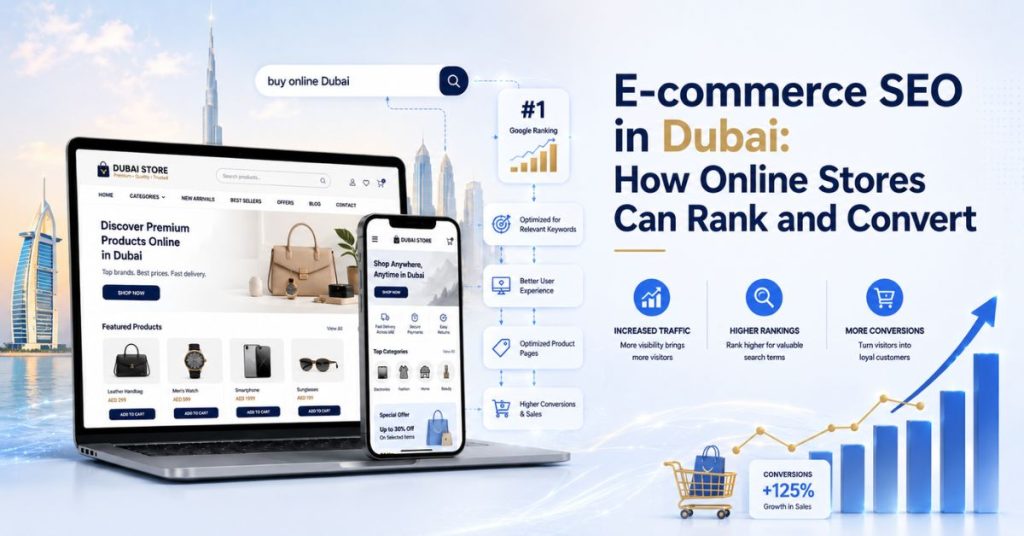
Dubai’s online retail market is growing faster than most businesses can keep up with. Consumers here are digital-first, mobile-savvy, and comparison-happy. If your store isn’t showing up on Google when someone searches for what you sell, you’re not just losing visibility. You’re handing sales to a competitor. That’s where ecommerce SEO Dubai strategies become non-negotiable for any brand serious about growth. Working with the right SEO services in Dubai can be the difference between a store that struggles to get traffic and one that consistently converts.
Why E-commerce SEO Is Different From Regular SEO
A service business might need to rank five or six pages well. An online store with 300 products needs all 300 of those product pages to be crawlable, indexable, and relevant to what buyers are actually searching. That scale alone changes how you approach almost everything.
Duplicate content is a real issue. When product variants, sorting filters, and paginated category pages all generate their own URLs, Google can end up crawling dozens of near-identical pages instead of the one you actually want to rank. Stores that don’t manage this properly often find their strongest pages buried while thin, low-value URLs absorb most of the crawl budget.
Search intent is another factor that trips up a lot of stores. Someone typing “buy running shoes in Dubai” is not researching. They want to purchase, today. Your product page landing on that search needs to answer that intent immediately, with pricing, availability, and a clear path to checkout. A page built for browsing won’t convert that visitor, even if it ranks.
The technical side is where a lot of stores quietly bleed rankings without realising it. A page that loads in four seconds on mobile, a site structure Google can’t read cleanly, missing structured data on product pages. None of these show up as obvious errors, but they add up. And unlike a bad product description, a deep technical problem usually takes months of work to fix once it’s taken hold.
Core Elements of a Winning E-commerce SEO Strategy in Dubai
1. Keyword Research Built Around Buyer Intent
Keyword research for e-commerce isn’t about finding the most searched terms. It’s about finding the terms that signal purchase intent. “Best laptop for students” gets searched a lot, but the person asking that hasn’t decided to buy yet. “Buy laptop online Dubai” or “gaming laptop UAE free delivery” tells you someone is ready to spend money right now. Those are the searches worth competing for.
A solid ecommerce SEO Dubai approach assigns keywords with purpose. Your category page for “men’s sneakers Dubai” targets the broad entry point. The product page for a specific Nike model goes after an exact query. A blog post comparing running shoe brands catches the buyer who’s still weighing options. Each page does a different job, and your keyword strategy should reflect that.
2. On-Page Optimization That Actually Converts
Getting your page to rank is one thing. Getting the person who lands on it to buy is another. Too many stores focus entirely on the first part and neglect the second.
Your title tag and meta description are essentially your ad in Google’s search results. They need your keyword, yes, but they also need a reason for someone to click your result over the four others on the page. Fast delivery, a clear return policy, price match, same-day dispatch. Something specific and tangible.
Product descriptions are where a lot of stores take shortcuts that cost them. Pasting in the manufacturer’s copy might save time, but it gives Google nothing unique to index and gives buyers nothing to trust. Write descriptions that answer the questions a customer would ask in a store: dimensions, materials, compatibility, what makes this version different from the cheaper one next to it.
A few other elements worth getting right on every product page:
- Image alt text: It helps Google understand what the image shows and opens up visibility in image search, which drives real traffic in product categories.
- Schema markup: Product schema surfaces pricing, stock status, and star ratings directly in search results, which noticeably improves click-through rates.
- Internal links: Pointing to related products and relevant categories keeps shoppers moving through your store and gives Google a clearer map of your content.
3. Technical SEO for Large-Scale Stores
Most e-commerce stores that struggle to rank have a technical problem somewhere. It might not be obvious from the front end, but Google sees things visitors don’t.
Speed is the most common culprit. Uncompressed images, bloated scripts, and no CDN can push load times well past what shoppers in Dubai will tolerate on mobile. Google’s Core Web Vitals measure exactly this, and poor scores affect rankings directly.
Beyond speed, larger stores need to think carefully about what they’re asking Google to crawl. Faceted navigation, URL parameters from filters, and auto-generated pagination can multiply the number of indexable pages by hundreds, most of them thin and nearly identical. Canonical tags and a well-configured robots.txt file help direct Google’s attention toward the pages that actually matter.
4. Category Page Optimization
Category pages get underestimated. Most stores pour attention into individual product pages while their category pages sit bare, with just a grid of thumbnails and nothing for Google to evaluate. That’s a missed opportunity because category pages are often where the highest-volume searches land.
A page targeting “wireless earbuds UAE” or “women’s abaya collection Dubai” can pull in far more traffic than any single product page. But only if it’s treated like a real content page: a descriptive H1, a short paragraph that uses relevant search terms naturally, breadcrumb navigation that reflects your site structure, and internal links that guide visitors deeper into the category. These aren’t decorative additions. They’re what separates a category page that ranks from one that sits on page four.
5. Content That Supports Rankings and Builds Trust
Product and category pages reach shoppers who already know what they want. But there’s a larger group of buyers still making up their minds, and content is how you reach them.
An electronics store in Dubai could write a comparison piece ranking the best gaming monitors under 2,000 AED. That article ranks for a research-phase query, brings in a qualified reader, and links directly to the relevant product pages. The reader comes for the guide and stays to buy. Google also uses this kind of content to assess whether your site genuinely understands its category or just lists products. Stores with strong content depth consistently outrank thinner competitors over time.
Local SEO Matters Too, Even for Online Stores
Online stores often skip local SEO on the assumption it’s only relevant if you have a physical location. But shoppers in the UAE regularly include location terms in their searches. “Online furniture store Dubai,” “buy perfume UAE delivery,” “electronics shop Sharjah online.” These searches have real volume and clear purchase intent.
Ranking for those searches isn’t complicated, but it does require intention. Your product and category copy should mention relevant cities and regions where it makes sense, not crammed in awkwardly but worked in where a customer would actually expect to see it. Your business name, address, and contact details should be consistent wherever they appear online. And links from UAE-based websites carry more weight here than generic backlinks from abroad. Google uses all of this to decide whether your store is genuinely relevant to someone searching from this part of the world.
Why Working With an Ecommerce Agency in Dubai Makes a Difference
Most store owners running SEO in-house are doing it between everything else they manage. Orders, suppliers, customer complaints, new product launches. SEO gets attention when things are quiet and gets ignored when they aren’t. By the time rankings drop noticeably, the problem has usually been building for months.
A dedicated ecommerce agency Dubai team runs SEO continuously, not reactively. Technical audits, content updates, link building, and performance tracking happen on a regular cycle rather than whenever someone finds the time. The compounding effect of consistent work over six to twelve months is what actually moves rankings in competitive markets.
Not every agency is worth hiring. The ones worth talking to have actually worked inside platforms like Shopify, WooCommerce, or Magento, not just run campaigns for generic websites. Ask them what they report on each month and whether their numbers connect back to revenue or just traffic and rankings. A good agency should be able to tell you which pages are losing conversions and why, not just that your keyword positions improved. That level of specificity is what separates an agency that understands e-commerce from one that’s guessing.
The Bottom Line
E-commerce in Dubai is a real opportunity, but the market is competitive and growing more so every year. Ranking on Google requires technical precision, content depth, and a consistent effort that doesn’t stop once you hit page one. Stores that treat SEO as a one-time project fall behind. Stores that treat it as an ongoing investment keep growing.
Paid ads stop the moment you stop spending. Organic traffic, built properly, keeps delivering. If your store is at the point where it needs consistent, compounding growth rather than a tap you’re always paying to keep open, SEO is where that starts. Stores across the UAE have found that working with a team that knows the local market makes a real difference in how fast that growth comes. If you’re outside Dubai and looking for that same level of support, the best SEO company in Sharjah is a strong place to start that conversation.