

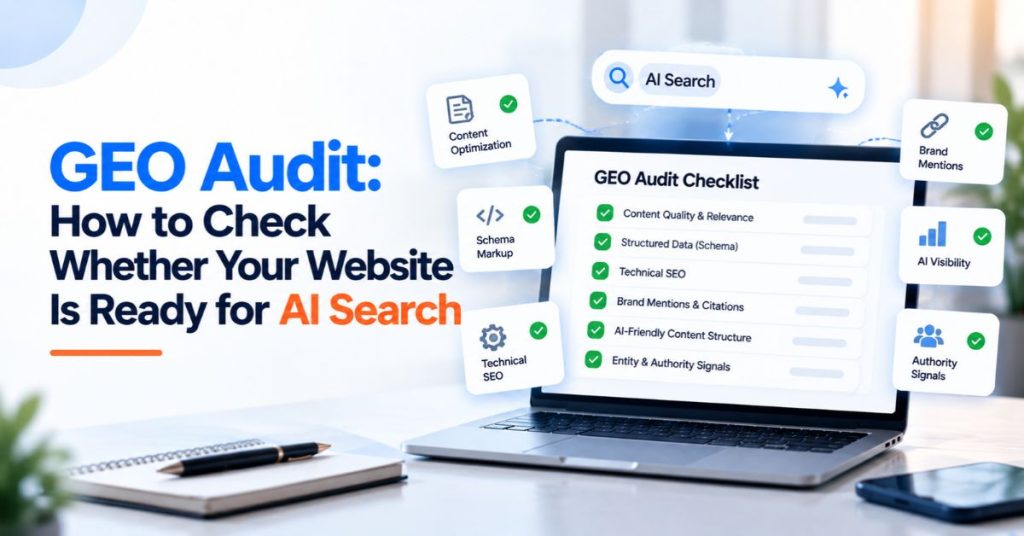
A GEO audit tests whether AI search systems such as Google AI Overviews, ChatGPT search, Perplexity and Gemini can access, understand and cite your website. The audit covers six areas: crawler access, rendered content, structured data and entity signals, answer-ready page structure, EEAT evidence, and actual citation performance across real prompts. Most failures come from basic faults, including a robots.txt file that blocks AI crawlers, service details that load only through JavaScript, and company information that differs between the website and its listings. At Infinix360, an SEO Agency in Dubai, we run this audit on websites before changing any content, because the findings decide which fixes produce results first. The sections below describe each check in the order we perform it, with the items to inspect and the faults we find most often.
What a GEO Audit Measures
A traditional SEO audit asks whether a page can rank. A GEO audit asks whether a page can be retrieved, understood and quoted inside a generated answer. GEO adds checks for entity consistency, passage-level clarity and third-party corroboration.
The audit produces a scored list of faults, each tied to a page, a cause and a fix.
Step 1: Check Crawler Access and Indexation
Open your robots.txt file and read every rule that applies to AI-related crawlers. A single broad disallow line left over from development can block all of them.
Check these user agents individually:
- Googlebot: Controls access for Google Search, which supplies the pages used in AI Overviews.
- OAI-SearchBot and GPTBot: OpenAI uses the first for search results and the second for model training, so businesses can allow one and block the other.
- PerplexityBot: Retrieves pages for Perplexity answers.
- Google-Extended: Governs use of content for Gemini training and grounding, and does not affect Search ranking.
Then confirm in Google Search Console that your key service pages are indexed and that no important page carries a noindex tag. Server logs show which bots request your pages, and a CDN or firewall rule can reject bot traffic even when robots.txt allows it.
Step 2: Test Rendering Without JavaScript
Many AI crawlers read the initial HTML response and do not execute scripts the way a browser does. View the page source, or fetch the URL with JavaScript disabled, and check whether your headings, service descriptions, prices and contact details appear in the raw HTML.
Pages built with client-side frameworks often return an empty container, which leaves the crawler nothing to quote. Text inside images creates the same problem. Server-side rendering or static generation resolves both.
Step 3: Audit Structured Data and Entity Signals
Validate your markup with Google’s Rich Results Test and the Schema.org validator, then compare it against the visible text, because markup that describes content missing from the page creates a trust problem.
Check for the following:
- Organization or LocalBusiness schema with legal name, address, phone number, logo and sameAs links to official profiles.
- Service schema on each service page, and Article schema with a named author and date on every blog post.
- FAQPage markup only where the questions and answers appear on the page.
Entity consistency matters as much as markup. Compare your business name, address, phone number and service descriptions across your website, Google Business Profile, LinkedIn and industry directories. In the audits we run, one company often appears under its trade license name on the website, a shortened brand name on Google Business Profile and an older office address in a directory. When these versions conflict, an AI system has no reliable way to tell which one is current, so it may leave the business out of an answer or quote the outdated detail.
Step 4: Review Page Structure for Extractable Answers
AI systems quote passages, not whole pages. Each section therefore needs to carry its own answer.
Review every key page against these points.
- The first sentence under each heading answers the question the heading raises.
- Each passage names its subject directly and avoids references such as “this” or “the above.”
- Facts that matter, such as service scope, timelines, pricing basis and service areas, appear in plain text and not inside images or PDFs.
- Arabic and English versions of a page carry hreflang tags and equivalent content.
Pages that open with three paragraphs of general background before reaching the answer score poorly in this check, and moving the answer to the top usually changes the score.
Step 5: Assess EEAT and Third-Party Corroboration
Experience, expertise, authoritativeness and trust must be visible on the page and confirmable elsewhere. Check each author page for credentials and links to professional profiles, and confirm that every claim about results cites a source, a project example or a measurable figure.
Then search for your brand name outside your own domain, including news mentions, industry directories, review platforms and partner websites. A business with no independent mentions gives AI systems nothing to cross-check against its own claims.
Step 6: Test Real Prompts and Track Citations
Build a Prompt Set
Write 25 to 40 prompts that a buyer would type, split between branded questions, category questions such as “which agency handles bilingual SEO in Dubai,” and comparison questions. Run each prompt on Google AI Overviews, ChatGPT, Perplexity and Gemini, and record whether your brand appears and which page is cited.
Record Baselines and Repeat
Answers change between sessions, so run each prompt at least three times and log the results in a spreadsheet. Open the traffic acquisition report in GA4 and filter the session source for chatgpt.com and perplexity.ai. Compare those sessions with your enquiry form submissions and WhatsApp clicks to see how many AI-referred visits ended in a lead.
Common Findings on UAE Business Websites
Three faults appear repeatedly in the audits we run for UAE companies. The first is a robots.txt rule left over from a staging build that disallows every crawler except Googlebot. The second is an Arabic page where only the headings are translated, which leaves the body text in English and gives the Arabic version nothing to quote.
The third is a service page of two or three short paragraphs with no named author, so the audit finds no evidence of expertise to confirm.
Run the Audit with Infinix360
At Infinix360, we deliver the audit as three documents: a crawler access report, a schema validation file and a prompt test log. Each one lists the fault, the affected URL and the correction. We run the same audit for Abu Dhabi businesses, and companies shortlisting SEO Companies in Abu Dhabi for GEO work can use these three documents as a measure of what a complete audit should produce.
Frequently Asked Questions
What is a GEO audit?
A GEO audit evaluates whether AI search systems can crawl, understand and cite your website.
How is a GEO audit different from an SEO audit?
An SEO audit measures ranking factors such as technical health, backlinks and keyword coverage. A GEO audit adds entity consistency, passage-level answer clarity and results from prompts run on AI platforms.
Should I block AI crawlers in robots.txt?
Blocking search crawlers such as OAI-SearchBot and PerplexityBot removes your pages from those platforms’ answers. Training crawlers such as GPTBot and Google-Extended can be handled separately, so the decision depends on whether you want your content used for model training.
How long does a GEO audit take?
A website with fewer than 50 pages typically takes one to two weeks, and prompt testing accounts for most of that time. Larger and bilingual sites need longer.
How often should I repeat the audit?
Repeat the prompt test monthly and the technical checks quarterly, and run a full audit after any migration or redesign.
Does schema markup guarantee AI citations?
Schema markup does not guarantee a citation. Markup labels a page as an organisation, a service or an article, which removes guesswork about what the page describes. A citation still depends on the page text answering the question and on other sources confirming that the business exists.