

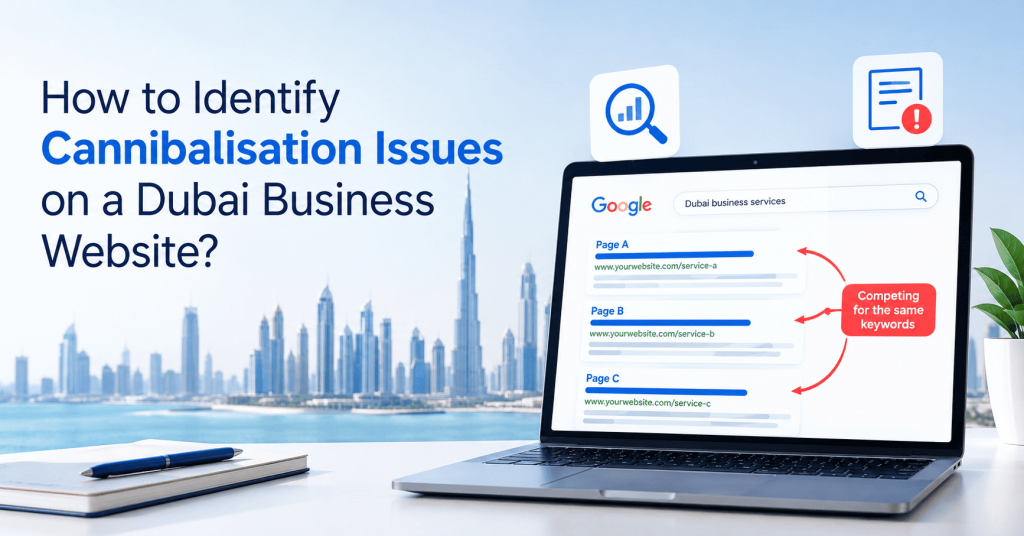
Keyword cannibalisation occurs when two or more pages on your website compete for the same search query and Google cannot decide which page deserves the ranking. Dubai business websites run into it often, because service pages, area pages, blog posts and Arabic versions frequently target the same terms. You can identify the problem with a structured process. Start with Google Search Console to find queries that return several URLs, group those queries by search intent, confirm the overlap with a site crawl and ranking history, and then decide whether each page should be merged, differentiated or redirected. Bilingual setups and multi-location pages need separate checks. If you are evaluating the Best SEO Agency in Dubai, ask for a cannibalisation audit first, since it shows how accurately a provider reads your data. The sections below follow the order we use at Infinix360, beginning with a clear definition of the problem.
What Keyword Cannibalisation Looks Like on a Dubai Website
Two pages mentioning the same keyword is normal. Cannibalisation starts when both pages satisfy the same intent, so Google alternates between them or ranks both below the position one consolidated page would hold.
Take a dental clinic in Jumeirah with a “teeth whitening Dubai” service page, a blog post titled “Teeth Whitening Cost in Dubai” and a landing page left over from a past campaign. All three describe the procedure, the price and the booking process. Google shows one page on Monday and another on Thursday, and none of them builds stable authority. The clinic sees impressions rise while clicks stay flat.
Backlinks split across several URLs, click-through rates drop, and the page that ranks is often the blog post instead of the page that takes bookings.
Why Dubai Websites Are Prone to Overlapping Pages
Several habits common to Dubai businesses create overlap without anyone planning it:
- Bilingual builds: English and Arabic versions with missing hreflang tags, so Google treats them as duplicates.
- Location pages: Separate pages for Business Bay, JLT and Dubai Marina with identical copy and only the area name changed.
- Free zone and mainland content: Several pages on DMCC, IFZA and mainland formation that all answer “business setup in Dubai”.
- Campaign leftovers: Ramadan and Dubai Shopping Festival offers that stay indexed after the campaign closes.
- Unmapped blog growth: Multiple posts on one subject, written months apart with no keyword map.
Signs of Cannibalisation in Your Data
The table lists the signals we check first and where each one appears.
| Signal | Where to find it | What it indicates |
| Several URLs ranking for one query | Search Console, Pages tab | Google considers more than one page eligible |
| Ranking URL changes week to week | Rank tracker history | Google keeps switching its choice |
| Blog post outranks the service page | Search Console query-to-page match | The commercial page is losing the query |
| Impressions rise while clicks fall | Search Console trend line | Split visibility is lowering click-through |
| Near-identical titles and H1 tags | Crawl export | The overlap is built into the pages |
How to Identify Cannibalisation Step by Step
Step 1: Pull Query and Page Data From Search Console
Open the Performance report, set the date range to the last three to six months and filter by United Arab Emirates if the UAE is your market. Select a high-value query and open the Pages tab. When two or more URLs show meaningful impressions, mark the query for review. Repeat this for your top 30 to 50 commercial queries.
Step 2: Group Queries by Search Intent
Two URLs for one query do not always signal a problem. A service page and an informational guide can both appear for “teeth whitening Dubai” while serving different intents. Review the live results for the query. If Google lists competitor service pages, your service page should be the target. If it lists guides, the informational page deserves the position, and the conflicting URL is the one serving the wrong intent.
Step 3: Crawl the Site and Compare On-Page Signals
Run Screaming Frog or a similar crawler and export titles, H1 tags, meta descriptions and canonical tags. Sort for duplicate and near-duplicate titles. Then search site:yourdomain.com “target phrase” in Google to see how many indexed pages use the phrase prominently. Review internal links as well. If the anchor “business setup in Dubai” points to four different pages, the site itself is creating the conflict.
Step 4: Review Ranking History
A rank tracker such as Ahrefs or Semrush records which URL held the position each week. Frequent switching confirms cannibalisation more reliably than a single snapshot does. Two URLs that alternate between positions 8 and 15 rarely reach the top five until you consolidate them.
Where Bilingual and Location Pages Hide Overlap
Arabic and English versions of a page should never compete with each other. Each version needs a self-referencing canonical and reciprocal hreflang tags using the ar-AE and en-AE values. Crawl the site for hreflang return-tag errors, since a missing return tag leads Google to rank the English page for an Arabic query, or the reverse.
Open the Business Bay and JLT pages side by side. When only the area name differs, merge them into one service page with an area section, or add content that applies to each area alone: nearby landmarks, travel times and local client examples.
Deciding What to Do With Each Overlap
Every conflict needs a decision based on intent and page strength.
| Situation | Action |
| Same intent, one page clearly stronger | Merge the weaker page into the stronger one with a 301 redirect |
| Different intent | Keep both, rewrite titles and H1 tags to separate them |
| Expired campaign page with backlinks | 301 redirect to the evergreen service page |
| Blog post targeting a commercial keyword | Retarget it to an informational query and link it to the service page |
| Duplicate location pages | Rewrite with local detail or consolidate |
After the changes, update the XML sitemap, request indexing for the retained URL and monitor the query for six to eight weeks.
How We Run a Cannibalisation Audit at Infinix360
We begin with a keyword map that assigns one primary query to each URL, then compare it against Search Console data, crawl exports and rank history to locate every conflict. Each audit ends with a spreadsheet listing the conflicting URLs, the cause, the recommended action and a priority level. Service and enquiry pages come first. After eight weeks we re-measure and report which queries settled on a single URL.
Conclusion
Cannibalisation appears in your Search Console data long before it appears in your enquiries, so run the audit before you publish another page. Whether you manage one office in Dubai or are comparing an Abu Dhabi SEO Company for a second location, each query needs one page, and each page needs a clear intent.
If you want your own site reviewed, our team at Infinix360 can start with your Search Console data and return a prioritised list of conflicts.
Frequently Asked Questions
What is keyword cannibalisation in SEO?
Keyword cannibalisation occurs when multiple pages on one website target the same search intent. Google splits impressions, links and clicks between them, which weakens each page.
How do I check for cannibalisation in Google Search Console?
Filter the Performance report by a specific query and open the Pages tab. If more than one URL receives impressions, the pages are competing. Repeat the check for your highest-value queries.
Is keyword cannibalisation always harmful?
No. A service page and a buying guide can both rank for one query when they serve different intents. The problem arises when both pages answer the same question.
Can Arabic and English pages cannibalise each other?
Yes, when hreflang tags are missing, incorrect or lack return tags. Google may treat the versions as duplicates and rank the wrong language for a query.
How long does it take to see results after fixing cannibalisation?
Most sites show movement within four to eight weeks after Google recrawls the changed pages. The timeline depends on crawl frequency and how many conflicts you resolve at once.
How often should a Dubai business audit for cannibalisation?
Run a full audit every six months and a quick Search Console check after each batch of new service, location or blog pages