

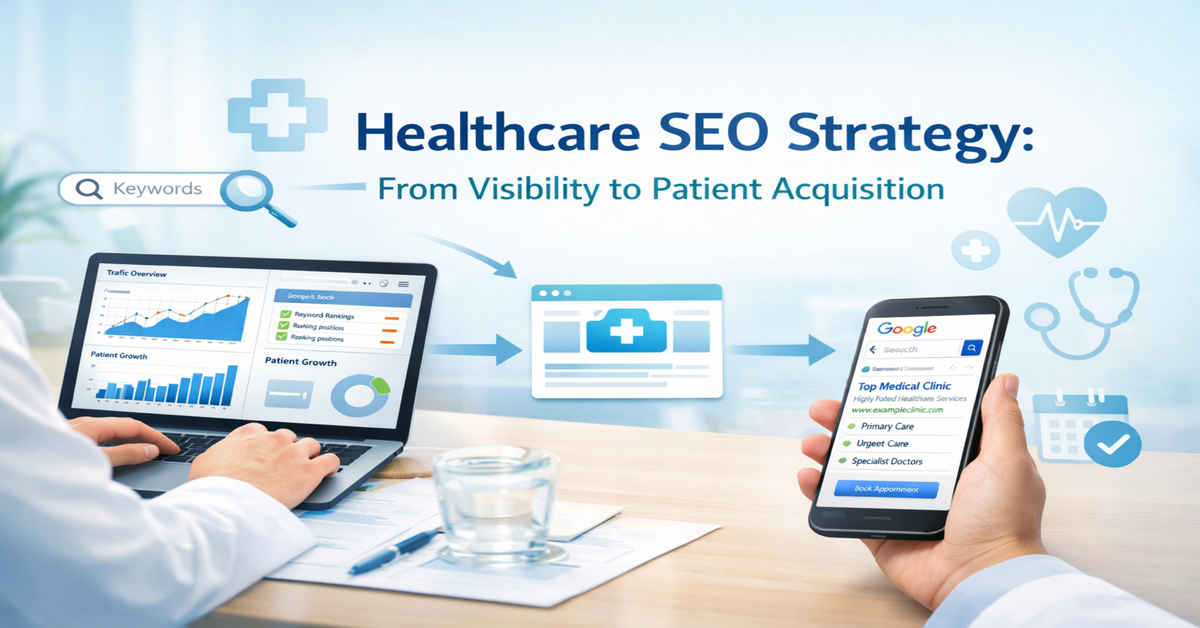
The digital patient journey is no longer linear. It doesn’t start with a recommendation over coffee anymore; it starts with a symptom typed into a search bar at 2 AM. For healthcare providers, being “good at what you do” is no longer the sole prerequisite for growth. If your clinic doesn’t appear when a patient is in that high-intent research phase, you simply don’t exist to them.
This is where a sophisticated healthcare SEO strategy from a reputed becomes the backbone of your practice’s growth. It is the bridge between being a choice and being the only choice.
Beyond the Search Bar: The Psychology of Patient Search
Healthcare is inherently personal. Patients aren’t looking for a product; they are looking for relief, expertise, and trust. When we talk about healthcare SEO, we aren’t just talking about ranking for “best cardiologist.” We are talking about mapping out every question a patient has from the moment they feel a localized pain to the moment they book a consultation.
Google’s algorithms, particularly those governing Your Money or Your Life (YMYL) topics, are ruthlessly strict. They demand E-E-A-T: Experience, Expertise, Authoritativeness, and Trustworthiness. A generic blog post written by a generalist won’t cut it in 2026. To truly master an SEO strategy for healthcare, your content must be medically verified, cited, and written in a way that provides genuine value before a single dirham is spent on ads.
Winning the “Near Me” Battle with Local SEO
For most medical practices, the primary battleground is local. If you are a dental clinic in JLT or a pediatric center in Khalifa City, you don’t need traffic from London. You need the person five kilometers away who just searched for “emergency dentist.”
This makes local SEO for healthcare the most critical component of your digital presence. It’s about more than just having a Google Business Profile. It’s about ensuring your NAP (Name, Address, Phone Number) data is identical across every medical directory, ensuring your “Services” section on your profile is granularly detailed, and proactively managing patient reviews. Reviews are the new digital currency. A practice with a 4.8-star rating and 200 detailed reviews will consistently out-convert a 5-star practice with only three reviews.
Patients look for specific local signals. They want to see photos of the clinic, know about parking availability, and see that other people in their community have had successful outcomes. By optimizing your local SEO for healthcare, you reduce the friction between a search and a physical visit.
Conversion: How to Get More Patients Through SEO
Traffic is a vanity metric; patient acquisition is the only metric that pays the bills. A common mistake many clinics make is driving thousands of visitors to a homepage that is cluttered, slow, or lacks a clear Call to Action (CTA).
If you want to know how to get more patients through SEO, look at your landing pages. Each specialty should have its own dedicated page. If a patient searches for “ACL reconstruction,” they should land on a page specifically about that procedure—not a general orthopedic page. This page needs to address their fears, explain the recovery process, and provide an easy, HIPAA-compliant way to book an appointment.
Speed is also a conversion factor. If your site takes four seconds to load on a mobile device, a patient in pain will hit the back button and click the next result. At Infinix 360, we emphasize that technical performance is just as important as content quality when figuring out how to get more patients through SEO.
The Roadmap: Building a Sustainable SEO Strategy for Healthcare
A successful SEO strategy for healthcare isn’t a “set it and forget it” project. It requires a multi-layered approach:
- Technical Foundation: Secure (HTTPS), mobile-first, and lightning-fast.
- The Shift Toward Topic Clusters: Google rewards depth. It no longer matters how many times “best cardiologist” appears on a page. What matters is if you answer the secondary and tertiary questions—recovery times, risk factors, or diet changes. Instead of keyword stuffing, you build a content ecosystem that proves you understand the patient’s entire journey.
- Trust Signals and High-Value Backlinks: This isn’t about directory spam. It’s about earning a digital referral from a local health authority or a recognized medical journal. One high-authority link from a UAE-based medical portal is worth more than five hundred generic blog comments. It tells search engines that the medical community itself trusts your expertise.
- Schema and On-Page Precision: Your website has a hidden layer. Using MedicalBusiness schema tells Google exactly what insurance you accept and what your board certifications are. This is surgical precision. If your technical data is messy, you lose out on the rich search results that actually drive clicks.
The UAE market is uniquely aggressive. In such a high-stakes environment, working with a specialized SEO Company in Dubai is often the only way to break into the top results. You need a team that understands why an Arabic search for a symptom in Deira requires a different content strategy than an English search in Dubai Marina. Generalist agencies don’t see those nuances; specialized ones do.
Measuring SEO Success for Healthcare
How do you know if it’s working? Many administrators get lost in the weeds of “total clicks,” but that doesn’t tell the full story. Measuring SEO success for healthcare requires looking at “Qualified Lead Volume.” Are the people calling your clinic actually looking for the high-value surgeries you provide, or are they just looking for a phone number for the pharmacy next door?
Key performance indicators should include your “Share of Voice” for specific treatments and your “Conversion Rate from Organic Search.” If you see your organic traffic growing but your appointment bookings staying flat, there is a disconnect between your visibility and your user experience.
Another aspect of measuring SEO success for healthcare is tracking “Assisted Conversions.” Often, a patient will find you through an organic search, leave the site, and come back three days later via a direct URL once they’ve discussed it with their family. A proper analytics setup will credit that original SEO effort for the final booking.
The Regional Edge: Dubai and Abu Dhabi
The UAE healthcare market is world-class, but it is also saturated. Whether you are a multi-specialty hospital or a boutique clinic, your digital footprint must reflect the same level of luxury and care that your physical facility does. Partnering with an SEO agency in Abu Dhabi ensures that your strategy aligns with local health authority regulations and the specific search behaviors of the capital’s demographic.
Healthcare SEO is not about “gaming” the system. It is about becoming the most helpful, most visible, and most trusted resource in your field. When you align your clinical expertise with a data-driven SEO strategy for healthcare, patient acquisition becomes a natural byproduct of your digital authority.
Conclusion
Visibility is the first step, but trust is the final one. By focusing on local SEO for healthcare and continuously measuring SEO success for healthcare, you move beyond mere rankings. You start building a sustainable pipeline of patients who chose you because you were the most helpful answer to their most urgent questions. If you are ready to dominate the digital landscape, it is time to look at how to get more patients through SEO and refine your presence for the long term.